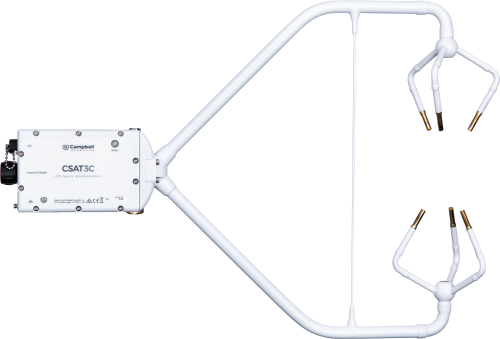


Overview
Building on more than three decades of field-proven sonic anemometer performance, the CSAT3C delivers reliable 3-D wind flux measurements in even the harshest environments.
First introduced in 1995, the CSAT3 set the standard for measuring turbulent fluxes with its non-orthogonal design optimized for eddy-covariance applications. Each generation has since evolved based on real-world field feedback, including the CSAT3B’s integrated electronics.
Now, the CSAT3C advances that legacy with a design hardened for challenging conditions.
While maintaining the same trusted measurement geometry and version 5 algorithm, the CSAT3C introduces meaningful durability and usability improvements, including improved and advanced coatings, dustproof and waterproof sealed connectors, and simplified installation. It provides three-dimensional wind measurements (Ux, Uy, and Uz) and sonic temperature (Ts) at output rates up to 100 Hz. The result is a reliable, long-term solution for accurate 3-D wind speed and direction monitoring, even in precipitation and very high winds.
Read MoreBenefits and Features
- Reduced flow distortion with a field-proven design
- Ability to capture rapidly changing turbulence conditions with a high-rate output
- Streamlined installation with a single-cable design
- Version 5 algorithm for calculating data outputs, combining the signal sensitivity of version 3 with the rain performance of version 4
- More diagnostics without added sensors
- Improved data accuracy in real time with online crosswind correction
- Refined flux measurements with optional Kaimal corrections
- Open outputs for direct integration into non-Campbell Scientific data loggers and computers without proprietary hardware requirements
Images
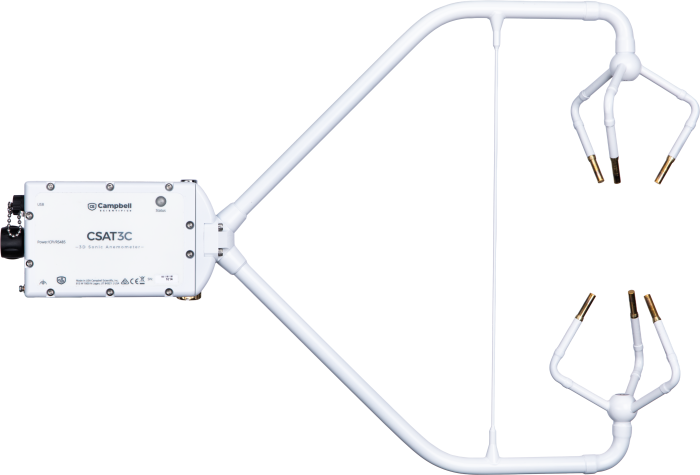

Detailed Description
Reduced Flow Distortion
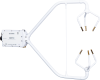
The CSAT3-series non-orthogonal, field-proven aerodynamic design has been cited in more than 100 peer-reviewed research papers. The CSAT3C retains this design, which is engineered to minimize flow distortion.
Reliable Operation
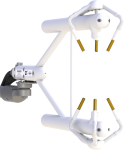
The CSAT3C has an upgraded transducer coating and sealed connectors.
Measurement of Rapidly Changing Conditions
The CSAT3C delivers up to 100 Hz output with selectable bandwidth filters for accurate flux measurements, making the CSAT3C ideal for turbulence and eddy-covariance studies.
Streamlined Installation
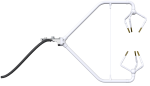
The CPIP cable carries power and communications in one cable. It is being standardized across all future Campbell Scientific micromet sensors to eliminate setup complexity and wiring errors in the field.
Additional Diagnostics
With a built-in inclinometer and internal temperature and relative humidity measurements, the CSAT3C provides additional context for data and system monitoring.
Improved Data Accuracy
The CSAT3C automatically corrects speed of sound and sonic temperature measurements to eliminate the need for additional post-processing.
Refined Flux Measurements
Optional Kaimal corrections account for transducer diameter and sonic path length, reducing flow distortion effects unique to the sensor geometry.
Compatibility
- CPI mode provides synchronization of all sensor measurements across complex topologies.
- RS-485 ASCII mode features 100 Hz unprompted output, selectable bandwidth filters, and high noise immunity on long cable runs, enabling direct integration into third-party data acquisition systems.
Specifications
| Measurement Description | Highest-quality wind speed and direction |
| Sensor | Three-dimensional sonic anemometer |
| Operating Temperature Range | -40° to +50°C |
| Measurement Path Length | 10.0 cm (3.9 in.) vertical; 5.8 cm (2.3 in.) horizontal |
| Transducer Angle from Horizontal | 60 degrees |
| Wind Full-Scale Range | ± 65 m s–1 |
| Sonic Temperature Resolution | ±0.002°C RMS (at 25°C) |
| Sonic Temperature Reporting Range | -40° to +50°C |
| Ingress Protection | IP67 |
| Compliance |
|
| Transducer Diameter | 0.64 cm (0.25 in.) |
| Transducer Mounting Arm Diameter | 0.84 cm (0.33 in.) |
| Support Arm Diameter | 1.59 cm (0.63 in.) |
| Overall Dimensions | 63.1 x 12.3 x 43.3 cm (24.8 x 4.9 x 17.0 in.) |
| Anemometer Head Weight | 1.9 kg (4.2 lb) |
Measurement Rates |
|
| Data Logger Triggered | 1 to 100 Hz |
| Unprompted Output (to computer) | 1, 10, 20, 50, or 100 Hz |
| Internal Self-Trigger Rate | 100 Hz |
Measurement Delay |
|
| Data Logger Triggered (no filter) | One trigger period (one scan interval) |
| Unprompted Output (no filter) | 10 ms |
| Filtered Output (data-logger-prompted or unprompted to computer) |
|
Internal Monitor Measurements |
|
| Update Rate | 2 Hz |
| Inclinometer Accuracy | ±1° |
| Relative Humidity Accuracy | ±3% (over 10 to 90% range) |
| Board Temperature Accuracy | ±2°C |
Power Requirements |
|
| Anemometer Voltage Requirement | 10.5 to 32 Vdc |
| Current at 10 Hz Measurement Rate |
|
| Current at 100 Hz Measurement Rate |
|
Wind Accuracy |
|
| -NOTE- |
Accuracy specifications assume the following:
|
| Maximum Offset Error | < ±8.0 cm s-1 (ux, uy), < ±4.0 cm s-1 (uz) |
| Maximum Gain Error |
|
Wind Resolution |
|
| ux, uy | 1 mm s-1 RMS |
| uz | 0.5 mm s-1 RMS |
CPI |
|
| -NOTE- | Used for Campbell Scientific data-logger-based, time-synchronized data acquisition |
| Baud Rate | 50 kbps to 1 Mbps |
| Cable Length |
|
| Address Range | 1 to 120 |
| Bus Clocks per Sample | ~300 |
RS-485 |
|
| -NOTE- | Used for third-party data acquisition system integration |
| Baud Rate | 9.6 kbps to 115.2 kbps |
| Cable Length |
|
| Bus Clocks per Sample | ~500 (ASCII formatted) |
USB |
|
| -NOTE- | Used for anemometer configuration |
| Connection Speed | USB 2.0 full speed 12 Mbps |
| Cable Length | 5 m (16.4 ft) maximum |
Documents
Product Brochures
Compliance
Downloads
CSAT3C Program Examples v.1 (3 KB) 11-09-2026
This download contains two example programs: one for reading the CSAT3C 3-D Sonic Anemometer on the CPI port and a second for reading the CSAT3C using RS-485 unprompted ASCII data collection. These programs are written for the CR1000X, but programming for other supported data loggers will be similar.
Frequently Asked Questions
Number of FAQs related to CSAT3C: 4
Expand AllCollapse All
-
Conveniently integrating both power and communications into a single cable, the CSAT3C uses the CPIPCBL cable. We expect to use this cable with future micrometeorology offerings for easy replacement.
-
Campbell Shield™ is Campbell Scientific’s internal benchmark for durability, reliability, and long-term performance in micrometeorology. Products that carry the Campbell Shield designation have been engineered and validated to meet a higher standard of resilience based on real-world feedback from researchers and operators.
The CSAT3C is the first instrument to carry this designation.
-
The CSAT3C is a 3-D sonic anemometer designed for accurate wind and turbulence measurements in harsh field environments. It measures three components of wind speed along with sonic temperature, making it well-suited for eddy-covariance applications, turbulence and flux research, and long-term environmental monitoring.
-
Campbell Scientific continues to offer the CSAT3BH Heated, 3-D Sonic Anemometer, which is ideal for icing and riming conditions.